
Visual Similarity
Match the rendered source states that an agent actually observes.
WEBANYTHING · RESEARCH PROJECT
Automatically reconstructing interactive, source-grounded web environments for agent training and evaluation.
Why WebAnything
Static capture misses interaction depth. Hand-built mirrors can scale poorly. WebAnything uses browser-observable evidence to reconstruct the visible state and the behavior required by an agent task.
Match the rendered source states that an agent actually observes.
Preserve controls, state transitions, routes, and deterministic reset.
Keep the complete path needed to finish the target workflow.
Method
The Builder and Verifier are separated by a frozen candidate boundary. Verification findings can trigger a focused loop without discarding the source evidence already collected.
Stage 01
The Builder follows the target task, records page states, and collects the evidence needed to reproduce the observed path.
Observed task depth
Statistics below use the 6,172 accepted source tasks whose execution traces were analyzed in the paper.
Evaluation
Results use distinct evaluation settings. Fidelity compares matched historical states; post-training reports the trained model under each benchmark's stated denominator and harness.
22/91 → 31/91, jointly valid tasks
Rubric Avg, 44 jointly valid tasks
Overall, internal harness
Task-driven case study
“在 Mermaid Live Editor 中,把默认流程图改为「草稿 → 审核 → 发布」,确认预览显示三个节点,然后导出 SVG。”
Edit the default diagram to “Draft → Review → Publish,” confirm all three nodes in the preview, then export an SVG.
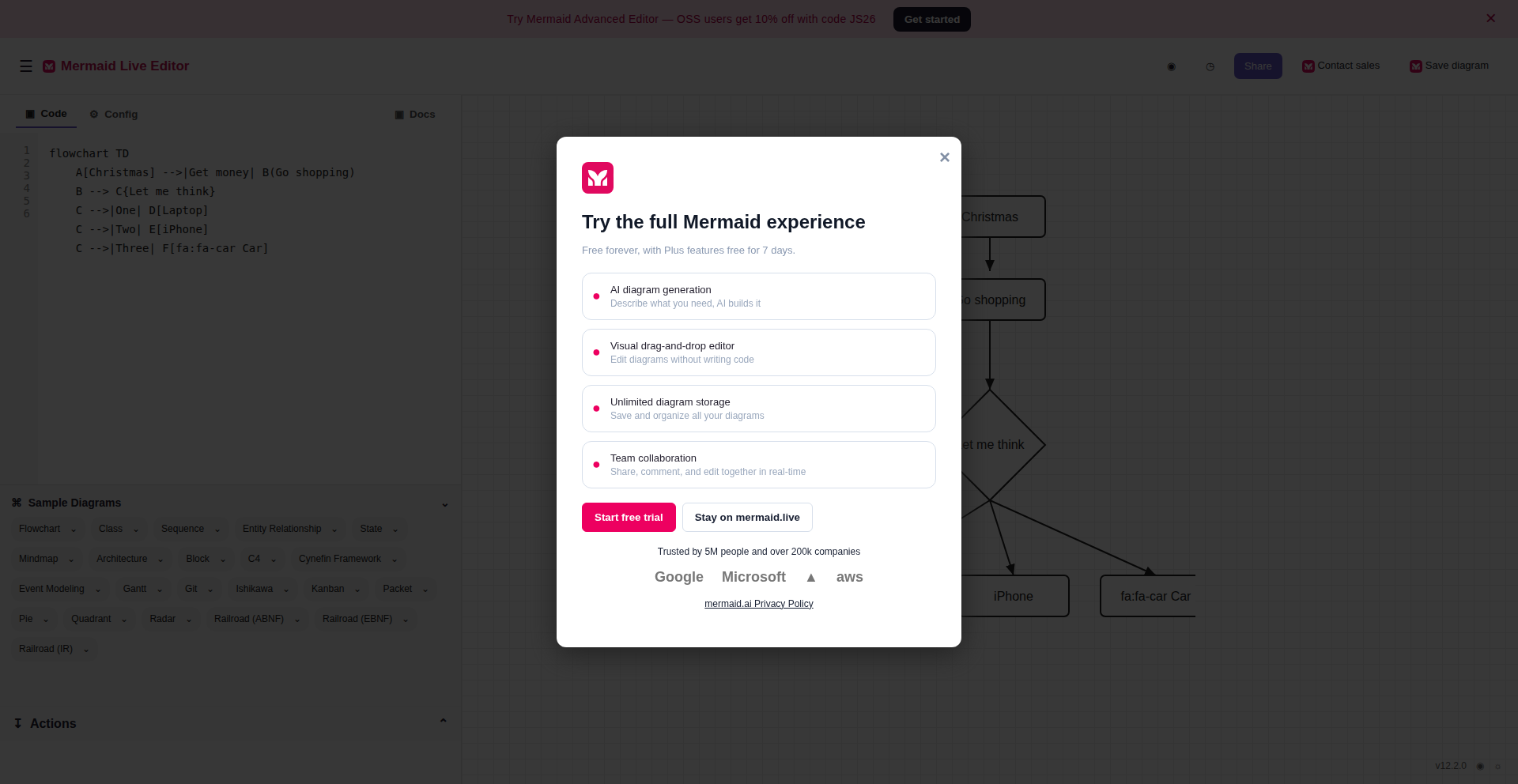
The replay edits the diagram, observes a responsive preview, opens the Actions menu, and downloads an SVG containing the requested labels.
Read the case studyScope note. The Verifier report passed. The original supervisor run stopped at blocked_retry_limit because its gate rejected structured JSON assertions; the validator and regression test were corrected and the saved Verifier output passed the repaired gate. This case establishes the demonstrated task path, not a fresh end-to-end supervisor pass.
Independent verification
The Verifier checks fidelity, functionality, safety, and reproducibility against the frozen candidate. Evidence gaps guide targeted recapture; implementation errors guide local repair.
Use WebAnything
Install the local skill once, then ask an agent such as Codex to reconstruct a site in Full or JIT mode. The repository includes the pipeline, verifier contracts, demos, and the 244-site metadata inventory.
# One-time setup
uv sync --locked --extra browser --extra visual --extra builder
uv run python -m playwright install chromium
npm --prefix tools/codex-mirror-trace ci
uv run webanything setup

# Then reconstruct a task path
uv run webanything create https://example.org/ \
  --mode jit \
--task "Complete the target workflow"@article{xie2026webanything,
title = {WebAnything: From the Wild Web to Scalable Agent Environments},
author = {Xie, Tianci and Cai, Zikun and Zhang, Chaoyun and Guo, Pinxue and Li, Bingxuan and Zheng, Rui and Yan, Hang},
journal = {arXiv preprint arXiv:2610.37786},
year = {2026}
}